
Otsego County Court Records After a Jail Arrest
The arrest-to-court path in Otsego County starts with booking and then moves toward the first appearance and formal prosecution. The Otsego County Jail records custody details such as intake, bail processing, holds, and release or transfer status. The court record is different. It is the case file built from an accusatory instrument, court appearances, judge orders, charge amendments, dispositions, warrants, and sentencing or release conditions.
The Otsego County District Attorney's Office prosecutes penal laws and vehicle traffic laws, including infractions, violations, misdemeanors, and felonies. The county DA page lists Christopher J. Di Donna as Acting District Attorney. The office is at 197 Main Street, Cooperstown, NY 13326-1129, and the phone number is 607-547-6464. The DA page also states that legal papers are not accepted by email or fax. That office role is why jail booking charges should be treated as early custody information, while prosecutor-filed charges are the court records to follow after an arrest.
For the custody side, use jail inmate records to separate current jail status from case status. For booking photographs and the limits on public photo access, use jail roster mugshots. Otsego research did not locate an official county web roster or booking-photo gallery, so court charge research should not depend on a county roster being available online.
From Arrest to Booking to Court Records
A recent arrest usually creates several records before a case is easy to search. First, the arresting agency or warrant authority supplies the basis for custody. Second, Otsego County Corrections processes the person at the jail, unless release happens before jail intake or the person is moved because of a hold or capacity issue. Third, the person goes to an arraignment or first appearance, where the judge addresses the charges before the court, release conditions, bail, remand, or another securing order.
After that first appearance, the prosecution path controls what appears in court records after the arrest. A complaint, simplified information, prosecutor's information, indictment, or superior-court information may define the charges. The DA can amend, reduce, add, or dismiss counts as the case develops. The court record may show the docket or case number, defendant name, court, statutes, charge level, upcoming appearance dates, warrants, disposition, and sentence information when available.
The official County Court page places Otsego County Court at 197 Main Street, Cooperstown, NY 13326-1129, with phone 607-322-3140. The county page lists Hon. John F. Lambert and Hon. Brian D. Burns and names Michael McGovern as county court clerk. Felony matters and county-level criminal proceedings may be handled through that court structure, while misdemeanors, violations, and traffic-related matters may begin in the town, village, or city court tied to the arrest location.
The county publishes its County Court contact page with the courthouse address, judges, clerk, phone, and fax.
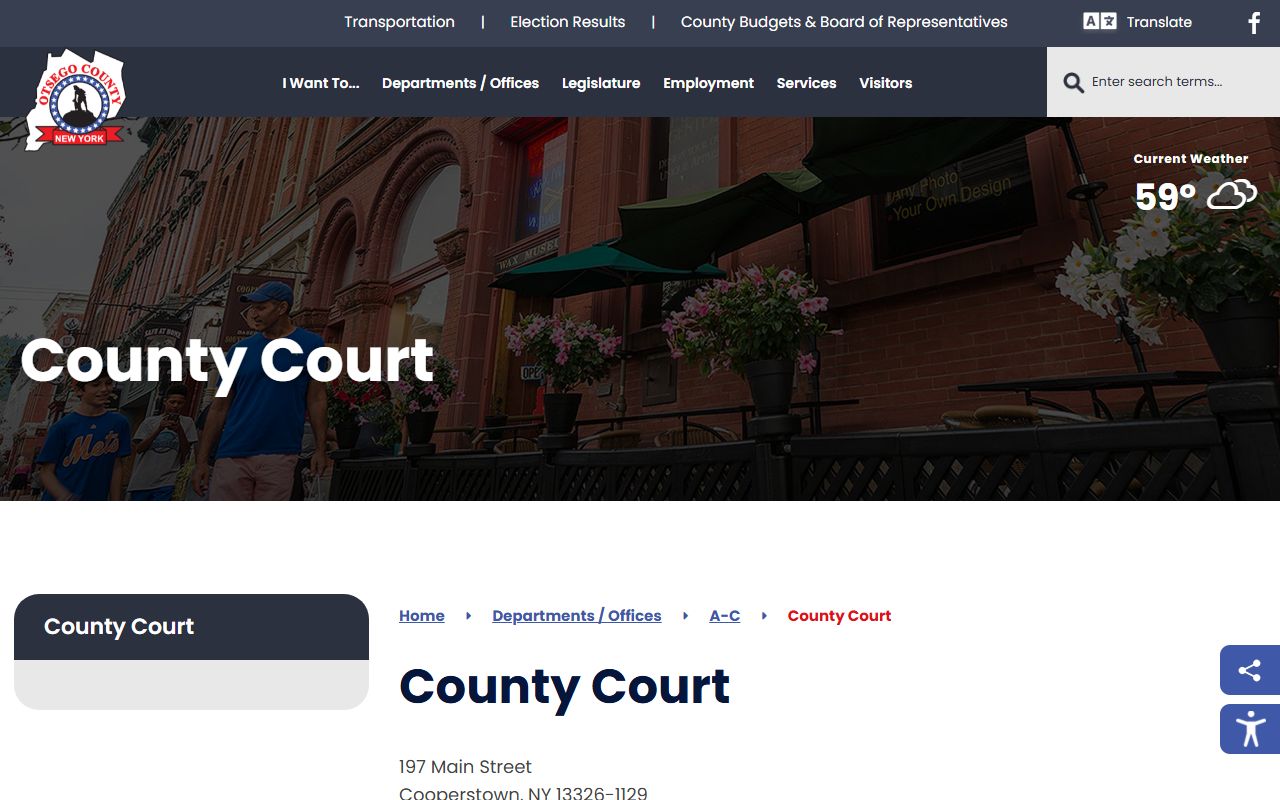
Use the County Court contact information when a felony or county-level case does not appear online, when an older file is needed, or when the arrest location points to a local criminal court that must be identified first.
How to Find Court Records After an Arrest
New York's WebCriminal system is the main online starting point for future criminal appearance information in selected courts. It is not a jail roster, and it does not replace a court clerk's file. It is useful because the visible portal offers three criminal search paths: Case Identifier, Defendant, and Court Calendar. If a case is newly filed, sealed, confidential, in a local court not fully reflected online, or not yet updated, the portal may not show the result the same day.
The New York Courts portal shows the WebCriminal search options used for criminal case and calendar lookup.
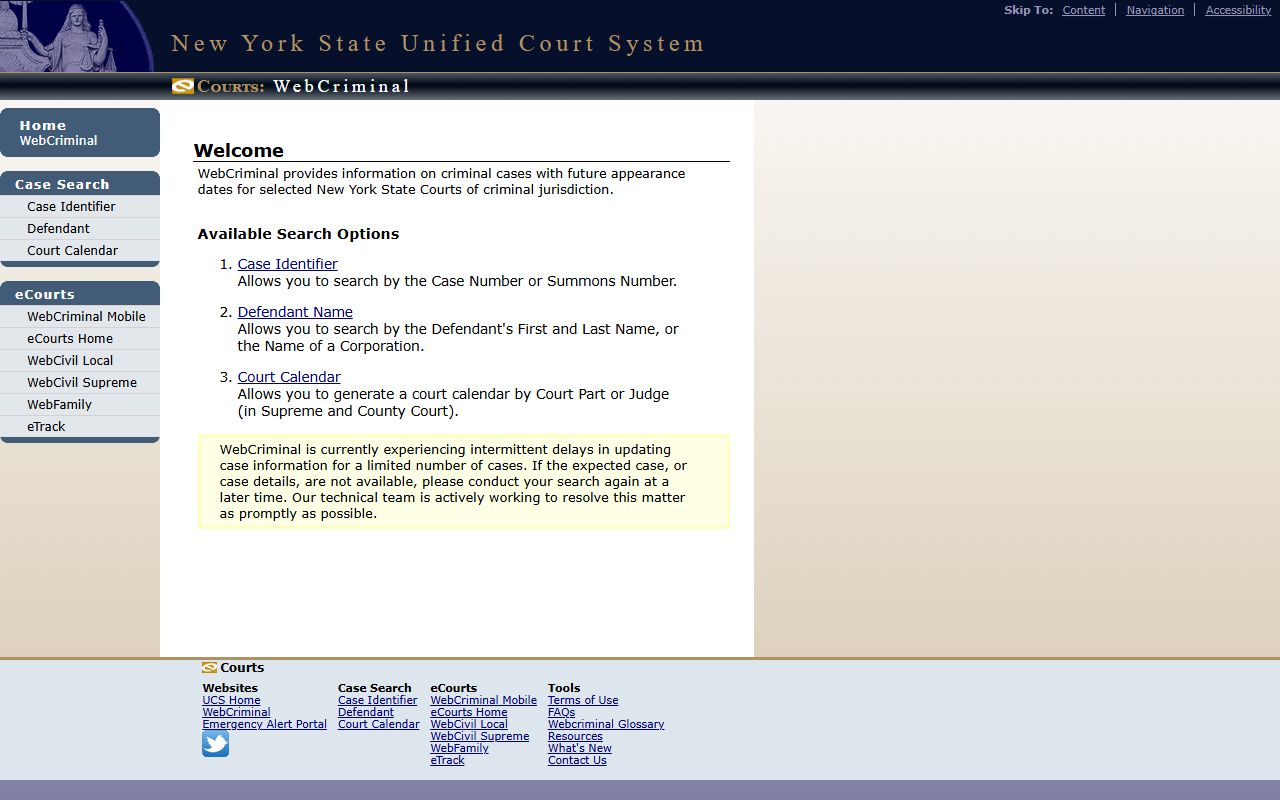
The portal is best read together with jail and clerk information: WebCriminal may point to an appearance date, while Corrections confirms custody and the clerk confirms the official case record.
| WebCriminal Search Field | Use | Notes for Otsego Arrest Cases |
|---|---|---|
| Case Identifier | Search by docket, case, or other known identifier. | Use this when paperwork from arraignment, bail, or counsel already gives a case number. |
| Defendant | Search by defendant name. | Useful soon after a jail arrest, but spelling, timing, sealed status, and local-court routing can affect results. |
| Court Calendar | Search scheduled appearances. | Use when the question is where and when the next court date is, not whether someone is still in jail. |
- Confirm custody first if the arrest is recent. Otsego County Corrections can be reached at 607-547-4252 because no official county online jail roster was located.
- Search WebCriminal by Defendant or Case Identifier for future appearance data and case details that are publicly available.
- If no record appears, check timing and court location. A new case may not be public online immediately, and sealed or confidential records will not display like ordinary cases.
- Contact the relevant clerk. For County Court/Supreme/County Court matters, use 607-322-3140. For local criminal courts, identify the town, village, or city court from the arrest location.
- For older or non-online court files, use the clerk process. The County Clerk background-check/court search process lists a $5 court search fee.
- For DA-office records that are legally releasable, use the DA records access route rather than the jail custody phone line.
Court Records After Arrest: Complaint, Information, and Indictment
A booking charge is the jail-side label tied to custody at intake. A charging document is the court-side instrument that tells the court what legal accusation is being prosecuted. The two can match, but they do not have to. A person may be booked on an arrest charge, arraigned on a complaint, later face a prosecutor's information, and eventually see the charge reduced, dismissed, or replaced by an indictment in a felony matter.
| Charging Document | What It Does | Common Otsego County Context |
|---|---|---|
| Complaint | Starts or supports a criminal accusation based on facts alleged by law enforcement or another complainant. | Often appears early, including around arraignment or first appearance after an arrest. |
| Information or Simplified Information | States charges in a form used for prosecution in the proper criminal court. | May be used for misdemeanors, violations, traffic matters, or amended/reduced charges. |
| Indictment or Superior-Court Information | Moves a felony matter into superior-court prosecution through grand-jury action or a permitted superior-court filing. | Relevant to serious felony matters handled through County Court structures. |
The DA's office is not the jail. Its role is prosecution, charging decisions, and records of prosecutorial action where those records are legally releasable. The DA contact page lists the Main Street address, phone, fax, and Traffic Division information.
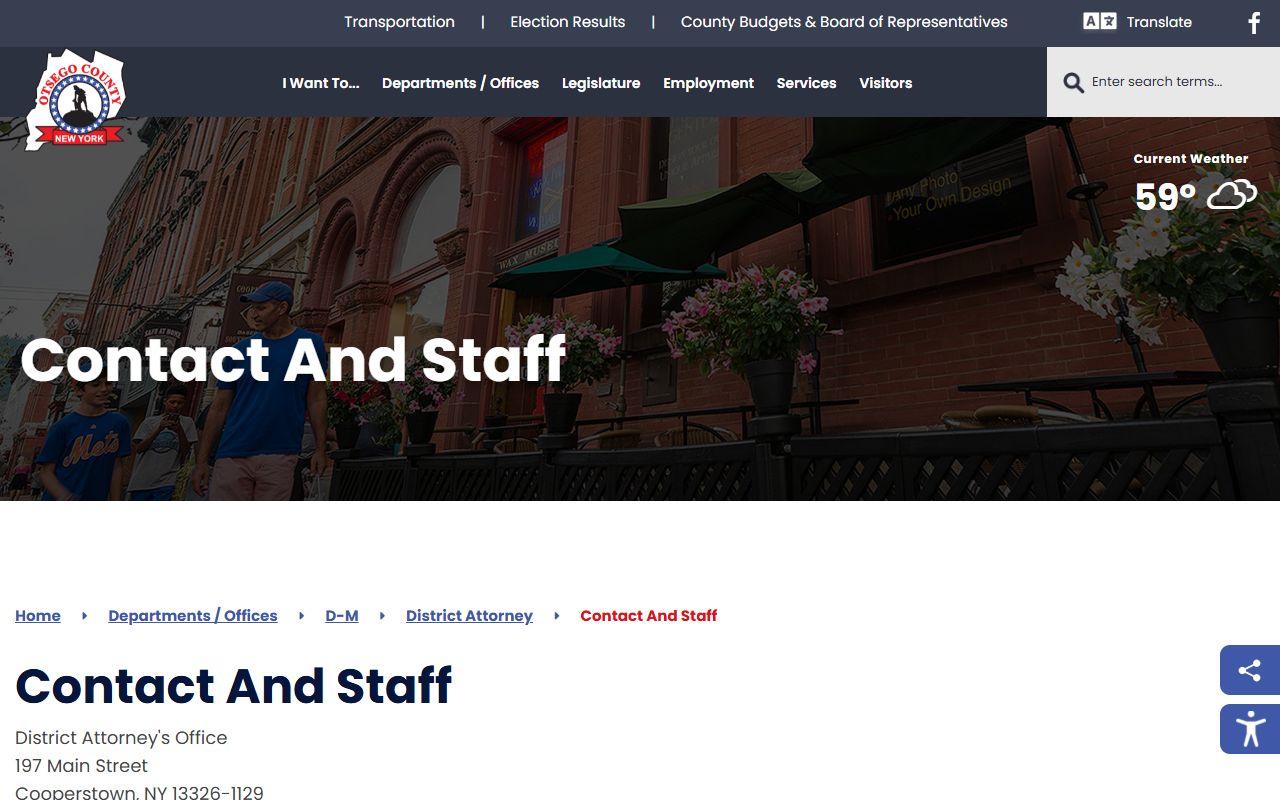
That DA contact should be used for prosecution-office routing, not for confirming whether a person is still physically housed in the jail.
Charge Status in Court Records After a Jail Arrest
Charge status changes are common. A count that appears at booking may be replaced by a formally filed charge. A prosecutor may reduce a felony allegation, amend a statute citation, add a related count, or dismiss a charge. The court may then record a disposition after plea, verdict, dismissal, acquittal, adjournment in contemplation of dismissal, or sentencing. For that reason, a court record after arrest should be read count by count, not as one simple label.
| Status | What It Means | Why It Matters |
|---|---|---|
| Pending | The charge remains unresolved. | There may be future court dates, release conditions, bail terms, or warrants tied to the case. |
| Amended or Reduced | The charge was changed by prosecutor or court action. | The formal court charge may no longer match the original jail booking charge. |
| Dismissed | The count or case was removed without a conviction on that charge. | A favorable termination may trigger sealing under CPL 160.50 when statutory conditions are met. |
| Convicted | Guilt was established by plea or verdict. | The record shifts from accusation to disposition and may affect sentence, custody, probation, or future background checks. |
| Warrant or Failure to Appear | The court may have issued a bench warrant or related order. | Custody status can change quickly and may not be fully reflected in online search results. |
First Appearance, Bail, and Court Records After Arrest
At or after the first appearance, the court issues a securing order. New York Criminal Procedure Law section 510.10 governs securing orders, including release on recognizance, non-monetary conditions, bail where legally available, and remand. The jail does not decide the legal bail amount. The court does, and the jail acts as a custody and payment-processing location after the order exists.
| Release or Hold Type | How It Works in Otsego County |
|---|---|
| Release on Recognizance | The court releases the defendant on a promise to appear, with no cash payment at the jail. |
| Non-Monetary Conditions | The court may order supervision, check-ins, or other conditions that do not require posting money bail. |
| Cash Bail | Otsego's official bail page says cash bail may be accepted at the facility and forwarded to the appropriate court. |
| Credit-Card Bail | The county bail page lists credit-card bail, with paperwork at the facility and phone access required. |
| Surety Bond | A payer works directly with a bondsman of the payer's choice. |
| Remand, Detainer, or Hold | Another warrant, parole hold, federal hold, state-ready status, or immigration issue may keep a person in custody even when local bail is addressed. |
Before traveling to post bail, call Corrections at 607-547-4252 and confirm the exact court order, amount, payment method, and whether any hold or transfer affects release. Bail paperwork can move faster than public online records, so a court record may lag behind jail processing or vice versa.
Warrants, Arrest Records, and Court Records
No official Otsego County active-warrant searchable database was located in the county and sheriff sources reviewed. A warrant can still be central to the court records after a jail arrest. An arrest warrant authorizes custody based on a criminal accusation. A bench warrant usually comes from failure to appear or violation of a court order. A fugitive warrant or hold may involve another jurisdiction, while a search warrant is different and does not itself prove a person is in custody.
If a person may already be booked on a warrant, call Corrections at 607-547-4252. For county-level court warrants or future dates, contact the court clerk at 607-322-3140 or the local court that issued the warrant. WebCriminal may show future appearances, but it should not be treated as a complete warrant database. Releasable warrant or arrest records may be requested through the sheriff FOIL process, while court orders and docket records belong with the court clerk.
Charge vs. Conviction in Court Records After Arrest
Being arrested and charged is not the same as being convicted. The presumption of innocence remains unless guilt is established by plea or verdict. This difference matters when reading court records after an arrest, because the visible record may list charges that were later dismissed, reduced, or resolved differently from the original booking entry.
| Question | Charge | Conviction |
|---|---|---|
| Record Stage | An accusation filed or pending in court. | A final finding of guilt by plea or verdict. |
| Proof Level | Based on legal accusation and probable cause standards, depending on the stage. | Requires proof beyond a reasonable doubt or a knowing plea. |
| What Can Change | May be amended, reduced, added, or dismissed. | May lead to sentence, probation, custody, fines, or other court orders. |
| How to Read It | Do not treat it as proof of guilt. | Read the exact offense, disposition date, sentence, and any later sealing or appeal information. |
Sealed vs. Expunged Court and Arrest Records
New York access rules are built around public records, exemptions, and sealing. FOIL, found in Public Officers Law Article 6, gives public access to agency records unless a statute or exemption allows denial or redaction. It does not override every privacy, safety, juvenile, youthful-offender, victim-privacy, medical, security, or active-investigation limit. Criminal Procedure Law section 160.50 provides for sealing of official records after termination of a criminal action in favor of the accused, subject to statutory exceptions.
| Question | Sealed | Expunged |
|---|---|---|
| Basic Meaning | Hidden from ordinary public access by court order or statute. | Destroyed or treated as erased in jurisdictions that provide expungement. |
| New York Context | CPL 160.50 sealing after favorable termination is the key rule for dismissed or favorably terminated criminal actions. | New York research for this project supports describing sealing, not promising a broad expungement process for Otsego arrest records. |
| Agency Access | Some law-enforcement, court, or statutory access may remain. | Do not assume no government access unless a specific order or statute says so. |
| Public Search Effect | Public court portals, FOIL responses, and jail records may withhold sealed material. | A commercial website result is not the official court record; removal from private sites is a separate issue. |
For a dismissed Otsego case, the practical record question is whether the court file, arrest record, jail booking material, and prosecutor record are sealed or otherwise withheld. Sealing should be handled through the court and counsel where needed, then addressed with each agency holding a copy of the record.
Background Checks and Court Records After Arrest
The County Clerk background-check/court search process is a local route for some record searches, and the research source lists a $5 court search fee. That clerk process is different from WebCriminal, different from the jail custody phone line, and different from a commercial background check. For public court research, keep the source straight: court clerk for court files, Corrections for custody, sheriff FOIL for jail or arrest agency records, and DA records access for legally releasable prosecution-office records.
Important: Otsego County Inmate Population is not a consumer reporting agency and may not be used for credit, employment, housing, insurance, or another FCRA-regulated decision.
Restricted Court Records After an Arrest in Otsego County
Some records connected to an arrest are not public even when the fact of a case or court date is visible. FOIL may allow an agency to withhold or redact records for privacy, law-enforcement, safety, or statutory reasons. The sheriff records page routes access requests through the Sheriff's Office and lists appeals to Sheriff Richard J. Devlin Jr. CPL 160.50 can seal official records after a favorable termination. Youthful offender and juvenile matters have separate confidentiality rules. Victim-identifying information, medical or mental-health details, jail security information, and active investigative material can also be limited.
The safest reading rule is to compare three sources without forcing them to match too early: jail or custody information from Otsego County Corrections, court and calendar information from WebCriminal or the clerk, and prosecution records from the District Attorney's Office when legally available. A booking charge can explain why a person entered jail; the filed court charge explains what the court is actually being asked to resolve.